
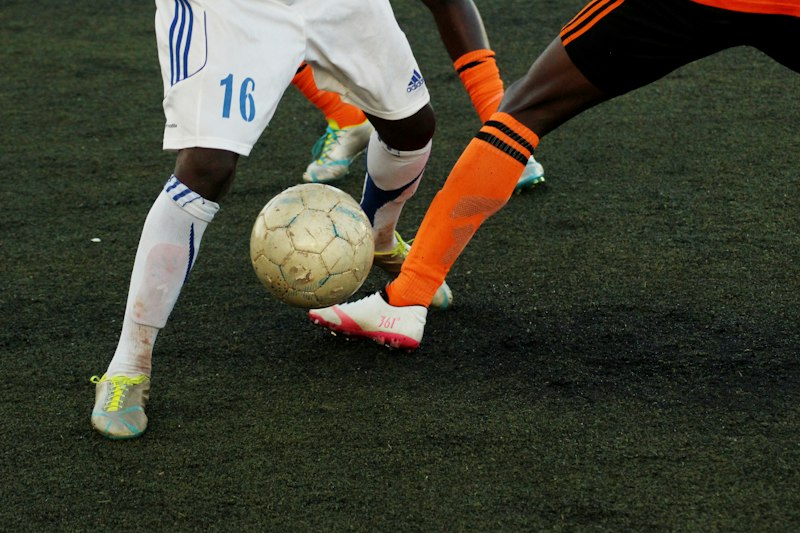
Watch a striker miss a good chance and then watch it again, and there's a reasonable likelihood that the shot was never the problem. The problem was the touch before it — a foot too far, at the wrong angle, or under the body instead of out in front.
By the time the ball is being struck, most of the outcome has already been determined. Which makes the first touch inside the box arguably the most important finishing skill there is, and it gets coached as though it's a basic that everybody mastered at twelve.
What the touch has to do
Three jobs, and they're often in tension.
Create striking distance. The ball needs to be far enough from the body that you can swing a leg through it, and close enough that a defender can't get to it. That's a window of maybe half a metre.
Set the angle. A touch that moves the ball slightly across your body opens a different part of the goal than one that pushes it straight ahead. Elite finishers use the first touch to choose their target before they've decided to shoot.
Buy time or remove pressure. Sometimes the touch has to go away from a defender rather than towards goal. Knowing when to prioritise this over the shooting angle is the judgement part.
Doing all three with a ball arriving at pace, at an awkward height, with contact, in the half-second you have, is genuinely difficult. It's not a basic.
The most common error
Taking the touch straight ahead, towards goal.
It feels right — you're moving the ball closer to where you want it to end up. But it takes you towards the goalkeeper, who is coming out, and it closes the angle rather than opening it. A striker who touches the ball forward on a one-on-one has usually just made his own finish harder.
The better default is a touch slightly across the body, away from the keeper's near-post position. It doesn't get you closer, but it moves the keeper's optimal position away from where he's standing and it gives you the whole far side of the goal.
You can watch this distinction repeatedly in any match. Same chance, two different players, and the one who touches it across scores.
Height is the hard part
The touches that go wrong most often are on balls arriving at knee or thigh height, which is exactly the height most crosses and cutbacks arrive at.
A ball on the ground can be redirected with the inside of the foot without much thought. A ball at chest height can be cushioned down. A ball at thigh height requires a decision about which surface to use and a cushioned contact that kills the pace without popping it up, and there's very little margin.
The good finishers use the thigh far more than most players do, and use it to direct rather than just to stop the ball. It's an under-trained surface — most technical sessions barely touch it — and it's the one that comes up most in the box.
What separates the elite
Two things, and neither is really about technique.
First: they know where the ball is going before it arrives, so the touch is pre-planned rather than reactive. That comes from watching the passer's body shape rather than the ball, which is a habit rather than a skill.
Second: they know where the goalkeeper and the defenders are without looking at the moment of the touch, because they scanned two seconds earlier. So the touch can be chosen for the situation instead of just being a control.
This is why the same technical action produces such different outcomes for different players. It isn't the foot. It's the information available at the moment the foot moves.
Coaching it
The mistake I made for years was training first touch and finishing as separate exercises. Touch drills with a wall, then finishing drills from a served ball placed conveniently.
The result was players with a good first touch in isolation who couldn't produce it when there was a goal to score, because the two skills had never been connected under any pressure.
What works better is finishing practice where the service is deliberately imperfect. Balls at awkward heights, slightly behind, slightly too fast. The touch is the actual exercise and the shot is almost incidental. It's less satisfying for the players — fewer goals, more mishits — and it transfers far better.
Adding a defender changes it again, because now the touch has to account for pressure. A passive defender is enough at first; the point is that the player has to decide where to put the ball rather than just executing.
The bit that annoys me
When a striker misses a good chance, the analysis is almost always about the finish. Should have hit it lower, should have placed it, should have taken his time.
Watch the touch instead. Nine times out of ten the ball ended up somewhere that made the shot difficult, and the striker did about as well as anybody could from where he was.
That's not to excuse bad finishing, which exists. It's to say that the diagnosis is usually wrong, and if you're coaching somebody, fixing a shooting technique that wasn't the problem is a waste of everybody's time.